
Trade Union
Definition: Trade Union is also referred as Labor Union, indicating an organized union, i.e. association of the labors, employed in a trade, industry, business or factory, etc who come together to achieve common goals, i.e. improving bargaining power on wages and working conditions.
Objectives of Trade Union
On behalf of the workers, it is the Trade Union which by way of its leadership, bargains and negotiates labor contracts with the employers. The objectives of the Labor/Trade Union are:
- To represent the individual workers, when they face a problem at work.
- To negotiate with the management about the issues which affect the workmen of the organization. The trade union also work for reducing the difference in opinion amidst management and union members.
- To safeguard the interest of the workers, by intervening in the improper implementation of the personnel policies which can directly or indirectly affect the workmen, such as layoff, retrenchment, promotion or transfer.
- To provide a range of services to the employees such as education and training, legal assistance, financial discounts and welfare benefits.
- To protect the health of the workmen, by demanding proper working conditions like lighting and ventilation, minimum working hours, paid leaves, drinking water, refreshments, sanitation, restrooms, social security benefits, safety equipment while discharging hazardous duty.
- To maintain harmonious relations between employee and employer.
The union deals with the basic problems encountered by the workers at their workplace such as fair pay, overtime, discrimination, working hours, unfair labor practices, holidays, so on and so forth.
Functions of Trade Union
The functions performed by trade unions are mainly divided into two groups: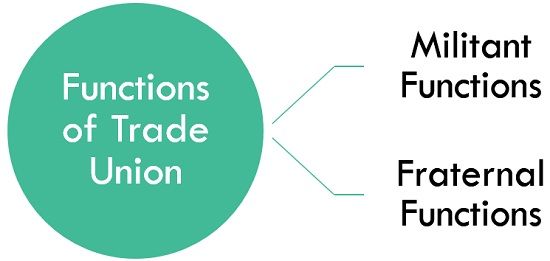
Militant Functions
As the name suggests, these are aggressive functions. And so trade unions undertake those activities which result in the upliftment of the position of the workers with respect to the employment. The main objective of such activities is – Adequate wages, Improved working conditions and fair and right treatment.
So, if the union fail to achieve these objectives, using methods like collective bargaining or negotiation, then they take recourse of another approach and raise their voice against management by using other techniques such as go-slow tactics, strike, boycott, gherao, and so on. Hence the militant functions involve:
Fraternal Functions
Fraternal functions involve friendly activities undertaken by the trade unions with an aim of providing help to its member, whenever they need and improving their level of efficiency. The trade unions work for cultivating a spirit of cooperation in members and encourage healthy industrial relations.
Further, they also work for spreading education among the members. Fraternal functions rely primarily on the availability of funds. Funds are generated by subscription from members and donations. So, these functions involve:.
The function of such unions is to ascertain the grievances of the workforce and collectively represent them before the company’s management. In this way, the trade union, works as a bridge between workers and management, for communication. Not just this, the unions are also accountable for maintaining discipline and unity among workers.
The presence of trade unions is also important for maintaining good relations between workers and management. They also take necessary actions on the misconduct or disobedience of workers, which disturbs the peace and harmony.
Understanding Human Resources (HR)
John R. Commons, an American institutional economist, first coined the term “human resource” in his book "The Distribution of Wealth," published in 1893. However, it was not until the 20th century that HR departments were formally developed and tasked with addressing misunderstandings between employees and their employers.1
An HR department is an essential component of any business, regardless of an organization’s size. It is tasked with maximizing employee productivity and protecting the company from any issues that may arise within the workforce.
HR responsibilities include compensation and benefits, recruitment, retention, firing, and keeping up to date with any laws that may affect the company and its employees.
Kenton .W (2024)
In summary, proactive communication, fair treatment, conflict resolution mechanisms, and initiatives aimed at employee satisfaction are key strategies that HR can employ to reduce the likelihood of union action within an organization. By addressing issues early and fostering a positive work environment, HR can effectively mitigate the need for external representation by unions.
REFERANCE
Business jargons available at https://businessjargons.com/trade-union.html , (Accessed on 27.03.2024)
Resources (HR): Meaning and Responsibilities available at https://www.investopedia.com/terms/h/humanresources.asp (Accessed on 04.03.2024)

Good blog keep it up
ReplyDeleteYour detailed explanation of the functions and objectives of trade unions provides a comprehensive understanding of their role in advocating for workers' rights and fostering better working conditions. It's evident that trade unions play a crucial role in representing individual workers, negotiating with management, and safeguarding their interests in various aspects of employment
ReplyDeleteThank
DeleteBasically, discuss here the positive impact of Trade unions.
ReplyDeleteClearly explain the function and objective of the trade union. You can further discuss the examples of activities by the union, the pros & cons that occurred by intervention, and how the action is in a global context.
The blog is well-written and well-explained, indicating a commendable job done.
ReplyDeleteHR & Union are both try to safeguard on employee base on two methods
ReplyDelete