Thursday, April 11, 2024

Creating Synergy: HR's Role in Bridging Generational Differences


 Managing a multigenerational team can present unique challenges, but there are strategies that can help bridge the generation gap and foster collaboration, communication, and engagement. From creating flexible work arrangements to offering professional development opportunities, this section provides tips and insights to help HR teams effectively manage and engage a diverse workforce.

Once HR teams understand the generational differences, they can create programs and initiatives that cater to the unique needs and preferences of each group.

Here are a few tips for managing and engaging a multigenerational workforceWhen new managers step in to lead a team, they are often faced with a shock to the system: their new team spans generations and they don’t know how to work together. Rather than worry about impending disaster, focus on understanding what makes your employees different, know their strengths and values, and find common ground.

First things first, let’s address the four generations spanning a single workplace:

Boomers - born between 1946-1964

Gen X - born between 1965-1980

Millennials (Gen Y) - born between  1980-1995

Gen Z - born after 1996


With vast age differences, lived experiences, beliefs, values, and attitudes, conflict can arise quickly among your employees. Examples of challenges with having different generations are: differing priorities, differing expectations, miscommunication, and varied training needs.

Before we dive any deeper, I’d like to offer a few caveats. First, remember that people are more complex than just their generation. Also, the following closer looks on each generation are broad brushstrokes—some people don't align with their generational behavior types or they are a blend. These guidelines should be used with caution as they are more of a tool to help you think about the differences between your employees than a steadfast rule of how each generation acts or thinks.

Here’s a closer look at the differences between each generation:

Boomers (born between 1946-1964) are of the “golden” age of employment—back when you stayed at a job for decades, put your head down and got your work done, and expected respect, hard work, and the salary that supports their life. Characteristics of this generation of employees are that they are experienced, loyal, hardworking, and sometimes traditional. Boomers value a strong work ethic, face-to-face communication, putting in the time, dedication to career, job security and respect for the hierarchy of an institution. They are used to working in a traditional office setting, with suit and tie, in-person collaboration, and working the Monday - Friday 9 to 5 schedule (and staying late when needed). They may be hesitant to change and wary of technological advances.

Working With Them: Respect their experience, make them the star of the show, use face-to-face communication, use public recognition and monetary rewards.

Gen X (born between 1965-1980) were the latchkey kids babysat by their televisions and let loose to explore the neighborhood until Mom called out the door for dinnertime. Gen X employees are independent, resourceful, and adaptable. They value self-reliance, a work-life balance, and are deeply results oriented with skepticism towards authority. They’ve embraced technology, but also value face-to-face interactions and prefer a balance of autonomy and collaboration.

Working With Them: Get to the point, don’t micro-manage, integrate technology, reward with time off and technology (e.g. new toys).

Millennials/Gen Y (born between 1980-1994) were born into a technological age and grew up in the millennium. Many began seeking employment during the job recession of 2008, and have learned to advance in their career they often have to leave their companies or “job hop”. They are tech-savvy, ambitious, team-oriented. They value personal growth, flexibility, meaningful work, and opportunities for growth and development in their career. Millennials are comfortable with remote work and digital communication, frequently seek feedback and mentoring, and look for flexibility in their schedules.

Working With Them: Give them frequent feedback, excite them with challenging projects, reward them with group and or social events and opportunities.

Gen Z (born after 1996, though some argue it starts in 1990) are shaped by the digital age, climate anxiety, a shifting financial landscape, and COVID-19. They are digital Natives, diverse and embracing diversity, entrepreneurial, and resilient. They value social responsibility, transparency, inclusivity and making an impact on the world. Gen Z employees are “the young ones in the office” who are highly adaptable to tech, prefer flexible work with a blend of in person and virtual, and freedom in their schedules.

Working With Them: Recognize and embrace diversity, support mental health, give opportunity to voice concerns, reward with opportunities.


So what does this all mean for your team, for your workplace?

For one, boomers are starting to retire out (though many are still having to hang in longer), Gen X are taking over executive and director roles, and Millennials and Gen Z make up the bulk of the workplace and are moving into leadership.

Senior workers’ believe that Millennial newcomers should have to “pay their dues” as they did when they were young workers. Because millennials have different expectations regarding work-life balance, Boomer and Gen X coworkers (current leaders), may question Millennials’ commitment and dedication to the organization.

Millennials and Gen Z expect close relationships and frequent feedback from supervisors and thrive on connections. Boomers might be ok with this to an extent, but eventually they might think Millennials and Gen Z lack the ability to work autonomously. While Gen Xers might be driven crazy because they like to work alone and expect Millennials and Gen Z to be self-reliant too.

The workplace will continue to get more diverse and continue to become more collaborative and flexible. Work-life balance will continue to become more important. There will be an increased attention paid to mental health and well-being.

To maintain a cohesive, motivated team working in harmony, you need to bridge generational gaps.

  • How do you navigate generational differences?
  • Set expectations
  • Engage in open communication
  • Identify roadblocks
  • Initiate change carefully

. (Zackrison.E 2023)


The generational Enterprise: Challenges and values 


Overcoming generational differences in workplace builds a culture that is focused on wealth of experience and perspectives

Diversity and demographics are two core strengths that organisations focus on today. However, generational differences can sometimes create friction in the workplace. Baby Boomers, Generation X, Millennials, and Generation Z often bring distinct perspectives, values, and work habits to the table. However, rather than viewing these differences as obstacles, organisations can turn them into opportunities for growth and innovation.

Employees from different generations working together can bring a wealth of experience and perspectives. It can also lead to generational differences that can cause friction and misunderstandings.

Here are some ways to overcome these differences and create a more harmonious workplace culture:

Foster a culture of mutual respect: Mutual respect is the cornerstone of any successful workplace culture, especially when dealing with generational diversity. Encourage open dialogue and active listening across all generations. Team members should feel comfortable sharing their ideas and concerns without fear of judgement. Cross generational programs pair employees from different generations together. Implementing cross-generational mentoring programs allows them to learn from each other’s experiences and perspectives. 

Organize team-building exercises: Team-building exercises are a fantastic way to bridge generational gaps. These activities promote teamwork, communication, and camaraderie among employees of all ages. When planning such exercises, make sure to cater to different interests and abilities to ensure inclusivity. For example, volunteering, marathons, workshops, are ways to bridge gaps in workplace generational diversity.

Embrace technology:  Different generations may have different preferences when it comes to technology. By embracing new technologies and providing training, you can help bridge the gap and ensure that everyone is on the same page. Consider adopting collaborative tools and platforms that facilitate communication and project management. These technologies can break down generational silos and streamline workflows, allowing employees of all ages to work together seamlessly.

Provide mentorship opportunities: Mentorship is a valuable resource for professional development and is especially effective in bridging generational differences. Create mentorship programs that pair older and younger employees. Establish reverse mentorship programs where younger employees can mentor their older colleagues on emerging trends and technologies. Younger workers can benefit from the wisdom and experience of their older counterparts, while older employees can learn from the fresh perspectives and innovative ideas of their younger mentees. 

Create a flexible work environment: Different generations may have different expectations when it comes to work-life balance. By providing flexible work arrangements, such as remote work or flexible hours, you can accommodate different needs and preferences.

Multi-generational task forces are a great way to address workplace policies and practices. These task forces can collaboratively design policies that accommodate the varying needs and expectations of each generation, ensuring fairness and inclusivity.

In conclusion, generational diversity in the workplace can be a source of strength rather than a challenge. Companies can harness the strengths of their workforce and better compete in the marketplace when they embrace generational differences and find ways to work together effectively.( Johnson.C,2023)


References

Johnson.C Navigating generational diversity in the work place ,Available at ; https://etinsights.et-edge.com/navigating-generational-diversity-in-the-workplace/

O’sullivan ,K , The generational Enterprise: Challenges and values , Available at,https://knowledgecompass.com/the-generational-enterprise-challenges-and-values/

Tolbize, A, Generational Differences in the workplace Available at https://rtc.umn.edu/docs/2_18_Gen_diff_workplace.pdf

Zackrison.E,How new managers can bridge generational gap in the workplace  Available at https://www.linkedin.com/pulse/how-new-managers-can-bridge-generational-gaps-eric-zackrison-ph-d--jsrrc/


Wednesday, April 10, 2024

Unlocking Talent: 12 Dynamic Recruitment Methods for Today's Businesses


12 recruitment methods you need to know about .

Organizations use many different types of recruitment methods to attract the best staff. Not every job has the same requirements, and each company has different needs. That means employers have to use hiring tactics that will match their environment and appeal to the candidates they’re looking for.

What is best: internal or external recruitment drives?

Neither is better than the other. There are pros and cons to both, depending on your business and the job you need to fill. So what’s the difference? Briefly, internal recruitment is when you source candidates to fill a role from within your existing workforce. External recruitment is when you go outside your company to attract people you’ve never met.

‍External recruitment brings new ideas, a fresh approach, and renewed energy. However, it is a costly and time-consuming process. Candidates have to be sourced, interviewed, assessed, and verified before a hiring decision is made.

 The 12 best recruitment methods you need to know about

Every recruiter knows that as much as we’d like to plan so that we can fill vacancies within the best time to hire hiring metric, things regularly don’t go as we’d hoped. Under pressure, we fall into old habits (that we know don’t always work) because hiring managers are turning up the heat.

The temptation to drop the job post on every available job board and cross your fingers that a great candidate will pop up is a common symptom of reactive recruitment. And sometimes we’re lucky, but more often, we’re not. 

As Sai Blackbyrn, CEO of Coach Foundation, said, “companies often rely too heavily on outdated or ineffective recruiting methods. Simply posting a job ad and hoping for the best is not a strategy. You need to use multiple channels to reach the right candidates, from employee referrals to social media to targeted ads.”


1. Direct advertising

One effective strategy for attracting job applicants is advertising your job openings on various platforms such as your company’s careers site, job boards, and social media platforms like LinkedIn. By doing so, you can reach a large pool of potential candidates and promote your employer brand, enhancing your company’s reputation in the market. However, external advertising can be quite costly, a major drawback to this approach.

2. Social media recruiting

More and more employers are now utilizing the power of the internet to search for potential job candidates. A recent survey by The Muse revealed that a whopping 91% of recruiters plan to use social media platforms like Facebook and Twitter to advertise job openings. Additionally, recruitment agencies can use job postings as a tool to promote themselves and get referrals from friends and relatives.

3. Talent pool databases

Instead of starting from scratch and posting the job opening online, look at your existing pool of applicants who were not hired in the past. There are likely a few individuals in there who were strong contenders for previous roles and may be a great fit for this new opportunity.

By searching your talent pool for the skills and experience required for your open role, you’ll be able to quickly identify a shortlist of candidates who are already familiar with your organization and have a proven track record of being strong contenders. 

This approach saves you time and effort and helps build a positive reputation for your organization by showing that you value the time and effort of all candidates who apply, even if they weren’t ultimately hired in the past.

4. Employee referrals

Many organizations have implemented an employee referral program to enhance their recruitment process. Referral programs combine both internal and external recruitment strategies, where current employees are encouraged to refer potential candidates for open positions.

This approach is highly beneficial as it is not only cost-effective but also fast. It is an effective way of ensuring that the referred candidates are suitable for the job since your employees are unlikely to refer individuals they don’t trust or believe would be a good fit.

5. Boomerang employees

Rehiring past employees has been gaining popularity in the last few years. Known as boomerang employees, these are people who worked well at a company but then left on good terms.

Employers recognize the benefits of rehiring former employees because they are already familiar with the company’s culture and their skills. Rehiring such employees reduces the time and cost of hiring and also eliminates the risk of making a bad hire. Thus, bringing back a boomerang employee is a great strategy for companies looking to save resources and maintain a productive workforce.

Check out our interview with Brian Westfall from Software Advice on his research on Boomerang employees

6. Promotions and transfers

Promotions and transfers are two different concepts, although they have some similarities. When a company has an open position, it may offer the job to one of its current employees. If the employee is offered a promotion, they will be moved up the career ladder and given more responsibilities, as well as a higher salary.

On the other hand, if the employee is offered a transfer, they will be moved to a different department or branch, but their responsibilities and salary will remain the same. Transfers can be either lateral or vertical, depending on the position and the employee’s qualifications.

7. Employment exchanges


In some countries, there are mandatory employment exchanges. The government runs these exchanges and maintains a record of job seekers who are currently unemployed. Employers can submit new job openings to the exchange and are provided with the necessary details about suitable candidates. This is a cost-effective way of finding candidates, but it is mostly suitable for more junior roles in factories, agriculture, and artisanal fields.

8. Recruitment agencies

You can outsource your hiring process to a recruitment agency. Agencies manage full-cycle recruiting on your behalf. Although the cost of using an agency is high, it frees up your time to focus on more pressing matters. Recruitment agencies are a great option for hard-to-fill positions and for companies that don’t have the internal HR resources to focus on hiring.

You can also hire an external recruiter to make contact with specific people that you would like to attract to your company. You might know of a passive candidate who’ll fit your role perfectly, but they work for your opposition, so you don’t want to make direct contact. An executive search recruiter, or headhunter, would be the perfect choice in this case.

9. Professional organizations

When you need to fill a highly skilled position, professional organizations can be an excellent source of candidates. Many professions require that people register with the appropriate professional association on qualification.
There are also other organizations where registration is voluntary, but it adds to the credibility of a candidate’s qualifications. Partnering with these associations and organizations can put you in touch with top talent.

10. Internships and apprenticeships

Offering internships and apprenticeships is an excellent way to assess the skills and abilities of individuals, and it can be considered a working interview. During this period, managers can evaluate the potential of interns and apprentices and identify those who can be trained and developed to fill future roles.
Everyone has to start somewhere, and future leaders are no exception. They all begin in entry-level positions, but well-managed internship and apprenticeship programs can be great platforms for recognizing and nurturing future talent and leaders.

11. Recruitment events

For big organizations, or companies planning expansion, recruitment events are perfect for attracting the type of people you need. Events can range from hosting open days to being at job fairs, holding a hackathon and graduate recruitment drives on campus. For example, Lego organizes “Brick Factor,” where 100 participants compete in building competitions and are offered jobs as Master Builders.

However, creating your own recruitment event can be expensive. To ensure you get the best ROI, you must know precisely what type of candidate you want to attract and what your employer value proposition is.

Job shadowing is another great way to get to identify potential candidates. It’s also an excellent means of promoting your employer brand and letting people know your company supports developing talent.

12. Word of mouth

Big brands and well-known companies can use word-of-mouth recruitment methods because unsolicited job seekers approach them daily. Their employer brand is established and recognized as an employer of choice. All they need to do is put the word out that they’re hiring, and they will get a good response.

‍( Smith.A 2024 )

 Pros of Using LinkedIn as a Recruitment Tool

Here are some advantages of using LinkedIn as a Recruitment Tool.

1. LinkedIn allows recruiters to reach out to passive candidates

LinkedIn states that 70% of its users are ‘passive candidates’. This indicates individuals who are not actively looking for a new job are very much active on LinkedIn. Therefore, such users are considered the perfect target for Recruiters. LinkedIn’s advanced search tool also aids them to identify these professionals with exact qualifications and experience.

Recruiters today do not spend time writing a job advert. Instead, they focus on making their recruitment process smarter by leveraging platforms like LinkedIn. They prefer to post jobs on LinkedIn, mostly on LinkedIn company pages as well as LinkedIn groups, which helps grab the attention of relevant LinkedIn members.

2. LinkedIn is Up-to-Date And encompasses

Everyone uses LinkedIn today, so why not use the platform to find the top talent? As long as candidates are actively searching for the best opportunity, they keep updating their profiles with the most recent experiences.

3. Consider Candidate Endorsements

It seems that every recruiter must know that in every candidate’s LinkedIn profile, there are endorsements of their skills. In addition to this, there are recommendations from the candidate’s network other than their previous and current job roles and concise skill set.

4. LinkedIn helps you hire the best talent quickly

Candidates having the experience to fill executive roles will generally have detailed LinkedIn profiles and a well-established network of contacts. This proves useful for recruiters who are trying to fill up high-level appointments.

5. LinkedIn helps you conduct reference checks

This LinkedIn feature allows recruiters to easily find common connections for quick reference checks.

Cons of Using LinkedIn As A Recruitment Tool

Hiring teams have also found some cons to using LinkedIn. Here are some disadvantages of using LinkedIn as a recruitment tool.

1. Passive Candidates May Not Be Interested

Unless candidates find a job, particularly enticing, being contacted by a recruiter in this regard may be time-consuming with very little payoff. The concept that hiring will be a lot more efficient via LinkedIn compared to other social media portals does not always pan out in practice. Recruiters may contact 15 candidates who they think are the best match for their company, but they might not get back to them. Job ads, on the other hand, are all about timing. Brevity and personalization are the keys to minimizing time wasted on contacting candidates who are not much interested. You can also use inmail messages to contact the desired candidates directly.

2. How credible Are Candidate Endorsements?

Endorsements do not reduce the time recruiters should spend checking references. Many users will only click ‘Endorse’, but it does mean very little unless they mean it. LinkedIn software is primarily driven by what the users are using it for. If the users are not using the ‘endorsement’ option in the right way, it is quite evident. If the network is real and not just a collection of profiles, the endorsers will mention how they know the person and what they know is great about them.

3. A Global Talent Pool

Learning to use the portal is easy. Learning to use LinkedIn like a Pro is no small task. However, the platform is accessible to users worldwide, which ensures there is a sheer volume of the talent pool available. This can be extremely overwhelming.

4. Escalated Costs

The LinkedIn Recruiter tool generally proves to be costly for smaller companies and those that do not hire very often. Such companies should, therefore, opt for a free tool like Jobsoid that helps maximize effectiveness. These companies can benefit from using the free LinkedIn service, provided that they work on their individual, as well as, business profiles. They should also try expanding their networks as it helps boost the search results.   Jamuni.P (2020) 

 References

Smith.A ,Talent strategy (2024) ,available at https://recruitee.com/articles/recruitment-methods  ( Accessed On 01.04.2024)

Jamuni.P (29.04.2020) Applicant Tracking System  Pros and Cons of using LinkedIn Recruitment Tool https://www.jobsoid.com/pros-cons-linkedin-recruitment-tool/ 


Unlocking HR Efficiency: Harnessing AI for Skills Gap Analysis


HR technology plays a crucial role in gap analysis by providing HR
professionals with the tools and insights needed to identify areas for
improvement and develop targeted strategies to address them. By leveraging
advanced data analytics and AI-driven algorithms, organizations can bridge the
gap between current practices and desired outcomes, ultimately driving
sustainable growth and success.

As companies experience a rapidly growing need to re-and upskill their people, the skills gap analysis is an increasingly relevant tool. A recent Wiley survey noted a significant uptick in the percentage of HR professionals and hiring managers who say they’re facing a skills gap. It rose from 55% to 69% in the past year.

What is a skills gap analysis?

A skills gap analysis is a tool used to assess the difference (or gap) between a workforce’s current capabilities and what is required to meet the current or future demands of the business strategy. It identifies the skills that employees need but don’t yet have to carry out their job or perform certain tasks effectively (Ovidio,A 2012).

Skills gap examples

Organizations that decide to tackle a skills gap issue can find ways to solve the problem. Here’s a look at a few examples of how companies identified skills gaps and took action to close them:

NASA

The U.S. government’s space research and exploration agency, the National Aeronautics and Space Administration (NASA), relies on data scientists for its operations. Since these professionals are in high demand, they looked internally at what the current workforce had to offer. Employees across the organization had data capabilities, but the wide range of talent had not all been categorized.

NASA was able to build a talent-mapping database that identifies the data skills required for various projects. It helps match employees with the right skill sets to projects requiring those competencies.

Verizon

Communications technology company Verizon has a goal of preparing 500,000 individuals for future roles by 2030. It developed a tech apprenticeship program called Verizon Thrive. The 12-month earn-and-learn program trains high-potential individuals in the important skills Verizon tech roles require.

After completing the apprenticeship, 95% of the first group of apprentices accepted full-time employment offers from Verizon.
Chipotle

Fast casual restaurant chain Chipotle faces the food service industry’s common struggles of high turnover and a lack of employees with management skills. In 2019, it started offering employees a debt-free college degree program that pays 100% of tuition costs upfront.

Chipotle’s employment retention rate is 3.5 times higher among crew members who are enrolled in the program. In addition, employees who take advantage of the benefit are 7.5 times more likely to be promoted to management roles.

AI-driven healthcare startup

Miriam Groom, CEO of Mindful Career and Leader Human Capital at KPMG, shared an example of a skills gap at an AI-driven healthcare startup. While their engineers were adept at developing cutting-edge algorithms, there was a gap in understanding healthcare nuances and patient-centric design,” said Groom.

“This revelation led the company to initiate a cross-functional TechMed collaboration program. Engineers were paired with medical professionals for immersive experiences, leading to a fusion of tech brilliance with empathetic, patient-first solutions. Not only did their product efficacy improve, but the company also reported an uptick in employee satisfaction due to this multidisciplinary learning.”


Why is a skills gap analysis important?

The Future of Jobs Report, the World Economic Forum states that 44% of employees’ essential skills and knowledge will be disrupted over the next five years due to continued automation and AI technologies.
For organizations across all industries, this means that certain jobs will disappear while others’ core tasks and responsibilities will change. This is where job redesign becomes relevant for rearranging these tasks and responsibilities to align them with the changing reality of work.

Before you start redesigning jobs, you need to know what skills and knowledge are currently missing in your workforce. You need to ask yourself, which of those skills are essential for your organization’s performance?

This brings us to why conducting an employee skills gap analysis is important. Here are several reasons:

1. It gives you insights into your entire workforce

You’ll be able to identify which employees have the most desired skills and knowledge of particular aspects of the business, as well as the employees with significant skill gaps.

As such, you can better target employee training and development efforts on those skills that require the most attention. This will lead to the optimal use of resources to improve the overall performance of the team. According to McKinsey research, matching training and development programs with skill needs can decrease costs by 50%.

2. It boosts individual learning and development

A skills gap analysis helps individual employees find out what improvements they’ll have to make to acquire or improve the skills and competencies needed to perform well now and in a future role. In the PwC’s Global Workforce Hopes and Fears Survey, 53% of employees stated that their job requires specialist training.

It will also highlight which employees are making the strongest contribution and deserve raises or promotions. This can also have a positive impact on your employees’ productivity.
3. It helps your strategic workforce planning

Strategic workforce planning is, among other things, about making sure you’ve got the right number of people with the right skills in the right place. It’s difficult to start planning for the future if you don’t know exactly where you currently stand from a skills perspective.

A skills gap analysis shows you which key positions lack core competencies. From there, you can set goals and define benchmarks for getting the workforce where it needs to be.
4. It can improve your recruitment efforts

You have to know what you are looking for in order to find it. It’s much easier to recruit strong candidates if you can identify the ones whose skills best match those needed to function effectively in a particular role.

You can also develop new talent acquisition strategies that will target and attract the types of people you need.

5. It creates a competitive advantage

If you combine all of the above, you’ll be able to create a competitive advantage and stay ahead of your competition. You’ll know the strengths and weaknesses of your workforce. That way, you can better plan for learning and development and recruitment to optimize your organization’s performance.

Skills gap analysis in the modern age isn’t just about identifying missing competencies but also about creating an organizational culture of continuous learning, adaptation, and collaboration.”


Miriam Groom, CEO of Career.M and Leader Human Capital at KPMG

References

Verlinden.N  ,Skill Gap analysis all you need to know Available at https://www.aihr.com/blog/skills-gap-analysis/ (Accessed on 01.04.2024)

Hot to do gap analysis ,https://youtu.be/AGQyaGtrTUc(2017)(Accessed on 01.04.2024)


Benefit on Diversity and Inclusion in Organization


CONCEPT OF DIVERSITY

 Whenever one thinks of diversity, ideas that readily come to mind include ethnicity, race and gender, but the issue of diversity has more to do than these. Loden & Rosener (1991) sees diversity as those attributes that emphasizes the need to accommodating others who are different from members within the group in which we belong. Put in another way, diversity could apply to another person who you see as beingdifferent from yourself. Diversity exists in different dimensions ranging from ancestry, gender, sexual orientation, age, marital status, sexual orientation, educational background, work experience, parental status, e.t.c. (Loden & Rosener, 1991) 

BENEFITS OF DIVERSITY 

According to courses.lumenlearning.com, theories abound on the reasons behind fostering diversity in business organizations. The arguments include enhancement of interpersonal innovation, availability of talent, and risk avoidance, appealing to an international database. The issue of diversity stems from the idea that diversity carries along with it some latent benefits, which include better decision making, enhanced solution to problems, increased skills, creativity, and innovation. All these benefits will definitely lead to better product development and marketing success to satisfy customer demands. 

Innovation 

In organization where diverse teams exist, implementation of better innovative and effective ideas is certain. The reason behind requires managers to find solutions from outside the organization’s normal way of doing things, using diverse perspectives to reach new and creative thinking. Individuals who share similar background and skills are much less likely to come across with new ideas that could lead to new product or new ways of productions A group of similar individuals with similar skills is much less likely to stumble across or generate new ideas that lead to innovation. Similarity leads to groupthink, which diminishes creativity.

 Localization 

An organization with diverse employees has a better of the knowledge of the various consumer markets that patronize her products and services. As a result, the organization is better equipped to survive in the global market than a business that has a limited or narrow range of workforce demographics. With increasing trade and economic growth in developing economies, Organizations need domestic talents to permeate foreign markets, compete and communicate effectively. Employees from a particular region are expected to have sound, deep understanding and knowledge of the needs of customers in that region, including their culture, and this enables the organization to add considerable value to what they offer to customers. 

Adaptability 

Current trend requires that organizations be able to adapt with emerging technologies and changing cultures. These qualities become very vital if the organization intends to remain competitive and compete favourably with competitors in the industry. Diversity engenders innovating thinking and improves decision making via a deeper and more comprehensivedifferent from yourself. Diversity exists in different dimensions ranging from ancestry, gender, sexual orientation, age, marital status, sexual orientation, educational background, work experience, parental status, e.t.c. (Loden & Rosener, 1991) worldview. An organization that is willing to engage in diversify benefits from a wider talent pool and recruits individuals equipped with diverse skill sets. The benefit of this, especially at the management level, is enormous. 

CONCEPT OF INCLUSION 

Inclusion is a situation in an organization when diversity exists among the workforce, creating an impartial and healthy working environment which guarantees equity in access to resources and growth opportunities for all. Inclusion means having an open, free and unbiased climate where every stakeholder in an organization can survive (Williams and Wade-Golden, 2013). Researchers at HRDQ (2014) itemized the following points as related to inclusive workplaces:  Every stakeholder is accepted and treated with respect.  Every employee gets fair hearing.  Employees behavior promotes inclusive environment  Rifts and disputes within the organization are addressed in impartiality.  The diversity of the workforce reflects the local society and people who constitute the market for the firm. In an environment where there is inclusion, participation and contribution of employees are maximized the existence of collaboration, support and respect. With true inclusion, all discrimination, intolerance and obstacles to personal development and growth are removed. When this is the case, everyone in the organization feels supported and included. 


Overall, HR's focus on diversity and inclusion can result in numerous benefits for organizations, including attracting and retaining top talent, fostering innovation and creativity, improving employee engagement and productivity, enhancing reputation and brand image, ensuring legal compliance, and expanding market reach.

(Krys .2019)


REFERENCES 

 Agocs, C., and Burr, C. (1996), ‘Employment Equity, Affirmative Actions and Managing 

 Diversity: Assessing the Differences,’ International Journal of Manpower, 17, (4/5), 30–45. 

 Bourke, J. and Van Berkel, A. (2017). Diversity and inclusion: The reality gap2017 Global Human Capital Trends, https://www2.deloitte.com/us/en/insights/focus/human-capitaltrends/2017/diversity-and-inclusion-at-the-workplace.html 

 Deloitte, Engaging the 21st Century Workforce, 2016 

Gartner, Inc. (2019). Gartner Says Diversity and Inclusion Are the No. 1 Talent Management Priority for CEOs; Most D&I Initiatives Ineffective. Newsroom Press Releases RLANDO, Fla.https://www.gartner.com/en/newsroom/press-releases/2019- 10-30-gartner-says-diversity-and-inclusion-are-the-no--1-ta 

HRDQ, (2014). How to Improve Cultural Competency in the Workplace. Pennsylvania, https://courses.lumenlearning.com/wmintroductiontobusiness/?s= Diversity in Human Resources

 Loden, M., Rosener, J.B., (1991). Workforce America! Managing Employee Diversity as a Vital Resource. Illinois: Business One Irwin 

Mondal, S. (2020). Diversity And Inclusion: A Complete Guide For HR Professionals. https://ideal.com/diversity-and-inclusion/ 

Myers, V. A. (2011). Moving Diversity Forward, American Bar Association, 

National Association of Diversity Officers in Higher Education, (NADOHE) 2018 

 Shen, J., Chanda, A., D’Netto, B. and Mongaa, M (2009). Managing diversity through human resource management: an international perspective and conceptual framework, The International Journal of Human Resource Management, 20(2), 235–251 

Williams, D. A. and Wade-Golden, K. (2013). The Chief Diversity Officer. Stylus Publishing,

Krys , Belonging :A conversation about equity, Diversity and Inclusion https://medium.com/@krysburnette/its-2019-and-we-are-still-talking-about-equity-diversity-and-inclusion-dd00c9a66113 2019.


Tuesday, April 9, 2024

Technological advances and people analytics trends in HR


Technological advances and people analytics in HR are revolutionizing decision-making, enhancing employee experiences, and fostering sustainable growth. AI, ML, and EXPs empower HR with data-driven insights. Responsible adoption is vital to address ethical concerns. Continuous learning is crucial for HR professionals to maximize benefits while minimizing risks in this evolving landscape.


Why Is HR Technology Needed?


We live in a technology-driven world. It’s obvious that HR technology is needed in today’s workforce. Here are several reasons:

1. Manage Remote Employees: Remote work is here to stay. HR technology is needed to manage and track employee attendance, performance, engagement, turnover, retention, and satisfaction, to name a few.

2. Streamline HR Processes: HR technology can automate current manual processes, making the HR team more productive and efficient. Wouldn’t it be nice to automate data entry, record-keeping, and reporting?

3. Improve Employee Data Quality: To have accurate people analytics, it’s essential that data is accurate and up to date. This can help HR professionals and executives feel confident that they are making informed decisions.

4. Enhance DEI Initiatives: Organizations are realizing the necessity of diversity, equity, and inclusion in the workplace. HR technology can help promote, measure, track, and report data on DEI metrics.

5. Improve Talent Management: Talent recruiting and acquisition, professional development, and succession planning are key for managing the workforce. HR technology can help with these talent management processes.

These are just a few areas where HR technology can help HR teams. In today’s rapidly changing and competitive business environment, HR technology is becoming increasingly important to drive better decision-making and business outcomes. Next, let’s cover the several types of HR technology.

What Types Of HR Technology Are There?


Now is the time to move away from gut feelings, instinct, and intuition and start using HR technology to help change how HR relates to employees, executive leadership, and the business as a whole. But what types of HR technology are there?

Let’s look at the various HR technology that Employee Cycle integrates with.

Applicant Tracking Systems (ATS)

These systems are used to manage and streamline the recruitment process, including posting job openings, tracking applicants, and scheduling interviews. Take a look at our Applicant Tracking integrations.

Employer Brand Platforms


These platforms are used for employers to share current job listings and allow current/former employees to share their experience working with that employer. Find out about our Employer Brand integrations.


Employee Engagement Systems

These systems are used to measure and improve employee engagement, track employee feedback, and provide tools for employee communication and collaboration. Learn more about our Engagement integrations.

Human Resource Information Systems (HRIS)

These systems are used to manage and automate HR processes such as employee data management, payroll, and benefits administration. Check out our pre-built HRIS integrations.

Learning Management Systems (LMS)

These systems are used to manage and deliver training and development programs for employees. Review our LMS integrations.

Use of artificial intelligence and machine learning

According to the IEEE Global Study, critical technological changes in 2023 will be artificial intelligence and machine learning (21%), cloud computing (20%), and 5G (17%).

With the desire to develop the business, 66% of world business leaders and analysts agree AI will drive most innovation in almost every industry over the next 1-5 years. For example, Mark Hornung, a senior employer brand strategist at exaqueo, believes that AI and ML will help HR managers reduce their workload while improving the overall productivity of their businesses further in 2023.


Reference 

        Applicant tracking system ,https://youtu.be/moMaFz-fTvg  , Youtube (Accessed on 30.03.2024)

        Empoyeecyle, how HR technology transforming people analytics                                                                                 https://www.employeecycle.com/how-hr-technology-is-transforming-people-analytics/                            Available at (Accessed on 30.03.2024)

            Lavri,o 7Digital HR technology trends, https://hrforecast.com/7-digital-hr-technology-trends/

Is it focuses to achieve same objective ?


Trade Union

Definition: Trade Union is also referred as Labor Union, indicating an organized union, i.e. association of the labors, employed in a trade, industry, business or factory, etc who come together to achieve common goals, i.e. improving bargaining power on wages and working conditions.

Objectives of Trade Union

On behalf of the workers, it is the Trade Union which by way of its leadership, bargains and negotiates labor contracts with the employers. The objectives of the Labor/Trade Union are:

  • To represent the individual workers, when they face a problem at work.
  • To negotiate with the management about the issues which affect the workmen of the organization. The trade union also work for reducing the difference in opinion amidst management and union members.
  • To safeguard the interest of the workers, by intervening in the improper implementation of the personnel policies which can directly or indirectly affect the workmen, such as layoff, retrenchment, promotion or transfer.
  • To provide a range of services to the employees such as education and training, legal assistance, financial discounts and welfare benefits.
  • To protect the health of the workmen, by demanding proper working conditions like lighting and ventilation, minimum working hours, paid leaves, drinking water, refreshments, sanitation, restrooms, social security benefits, safety equipment while discharging hazardous duty.
  • To maintain harmonious relations between employee and employer.

The union deals with the basic problems encountered by the workers at their workplace such as fair pay, overtime, discrimination, working hours, unfair labor practices, holidays, so on and so forth.

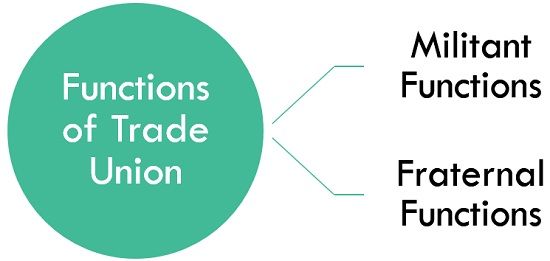
Functions of Trade Union

The functions performed by trade unions are mainly divided into two groups:functions-of-trade-union

Militant Functions

As the name suggests, these are aggressive functions. And so trade unions undertake those activities which result in the upliftment of the position of the workers with respect to the employment. The main objective of such activities is –  Adequate wages, Improved working conditions and fair and right treatment.

So, if the union fail to achieve these objectives, using methods like collective bargaining or negotiation, then they take recourse of another approach and raise their voice against management by using other techniques such as go-slow tactics, strike, boycott, gherao, and so on. Hence the militant functions involve:

Fraternal Functions

Fraternal functions involve friendly activities undertaken by the trade unions with an aim of providing help to its member, whenever they need and improving their level of efficiency. The trade unions work for cultivating a spirit of cooperation in members and encourage healthy industrial relations.

Further, they also work for spreading education among the members. Fraternal functions rely primarily on the availability of funds. Funds are generated by subscription from members and donations. So, these functions involve:.

The function of such unions is to ascertain the grievances of the workforce and collectively represent them before the company’s management. In this way, the trade union, works as a bridge between workers and management, for communication. Not just this, the unions are also accountable for maintaining discipline and unity among workers.

The presence of trade unions is also important for maintaining good relations between workers and management. They also take necessary actions on the misconduct or disobedience of workers, which disturbs the peace and harmony.

Understanding Human Resources (HR)

John R. Commons, an American institutional economist, first coined the term “human resource” in his book "The Distribution of Wealth," published in 1893. However, it was not until the 20th century that HR departments were formally developed and tasked with addressing misunderstandings between employees and their employers.1

An HR department is an essential component of any business, regardless of an organization’s size. It is tasked with maximizing employee productivity and protecting the company from any issues that may arise within the workforce.

HR responsibilities include compensation and benefits, recruitment, retention, firing, and keeping up to date with any laws that may affect the company and its employees.

 Kenton .W (2024)

In summary, proactive communication, fair treatment, conflict resolution mechanisms, and initiatives aimed at employee satisfaction are key strategies that HR can employ to reduce the likelihood of union action within an organization. By addressing issues early and fostering a positive work environment, HR can effectively mitigate the need for external representation by unions.

REFERANCE 

 Business jargons available at https://businessjargons.com/trade-union.html , (Accessed on 27.03.2024)

 Resources (HR): Meaning and Responsibilities available                               at https://www.investopedia.com/terms/h/humanresources.asp (Accessed on 04.03.2024)